

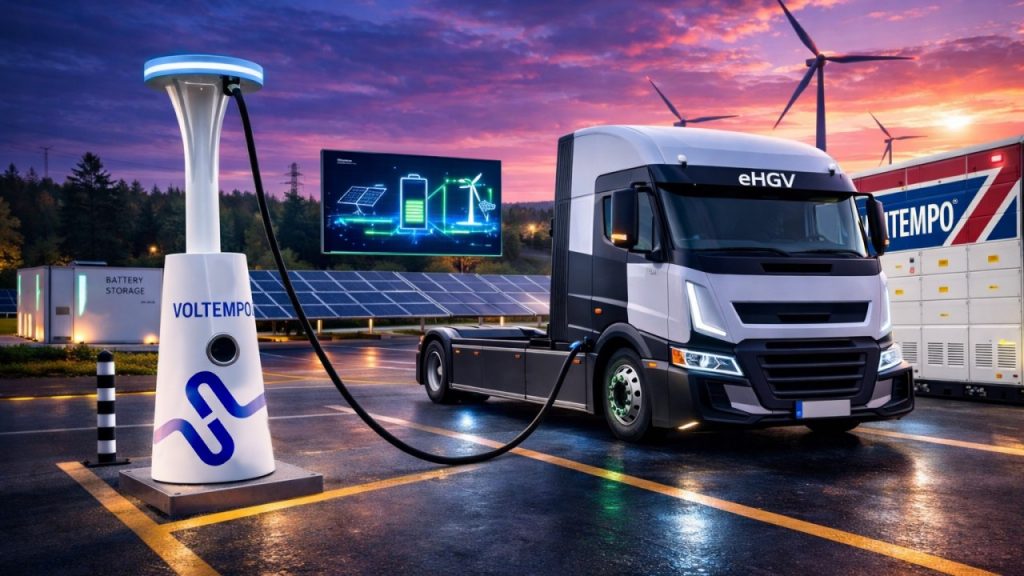
eHGVs are set to become one of the most important flexibility assets in the country.
With electric heavy goods vehicle charging infrastructure transformed into a strategic energy asset that forms part of the very foundation of the UK energy system.
That’s the immense opportunity that now lies ahead and exactly what Voltempo‘s systems and technology were created to enable.
Ensuring this transformation is done so in the optimal way is the focus of Future Fleet.
Voltempo is delighted to be a key partner of the project, which is being led by UK Power Networks (UKPN) and supported by Innovate UK.
Future Fleet is providing the first detailed picture of how, where and when electric HGVs will charge, helping map real‑world operational patterns that will guide the rollout of high‑power charging infrastructure. It was recently announced that the project has secured backing from Ofgem’s Strategic Innovation Fund, marking an important step forward.
The innovation is bringing together key partners to define real-world operator archetypes and match them with tailored energy solutions. This includes flexible connections, co-located storage and managed charging, identifying the most cost-efficient pathway to large‑scale decarbonisation.
Its work comes at a pivotal moment.
In tandem, the Government’s REMA initiative is reshaping the electricity market to make it more strategic, coordinated and efficient: retaining a single GB wide wholesale market while introducing new tools like the Strategic Spatial Energy Plan and reformed network charging. These reforms are designed to give investors greater certainty and create a smarter, more flexible energy system.
Taken together, Future Fleet’s insights and REMA’s reforms point to a powerful vision: eHGVs and the eHGV charging network providing one of the grid’s most valuable sources of flexibility.
High‑power eHGV hubs, equipped with smart scheduling, on‑site storage and renewables, can help fleets reduce costs today while positioning themselves to earn from future flexibility and ancillary services markets. REMA explicitly aims to expand and modernise these markets through improved balancing, constraint management and system efficiency.
To unlock this potential, we first need to understand where the opportunities lie. That’s exactly what Future Fleet is designed to do. From fleet archetypes to geospatial analysis, the project is building the evidence base needed to deploy megawatt charging in the right places, at the right scale, with the right smart‑energy capabilities.
At Voltempo, we’re excited to be part of Future Fleet and about what this all means. As the UK moves toward a cleaner, smarter and more resilient power system, eHGV charging infrastructure isn’t just keeping fleets moving, it’s merging into the very heart of Britain’s future energy system.
As someone who has been involved in power and innovation my whole career, I’ve seen many transitions, but few as exciting or as consequential as this one.
The convergence of transport and energy – shaped by projects like Future Fleet, driven by technology partners such as Voltempo and strengthened by expert collaborators including Maritime Transport, Baringa, Energy Systems Catapult and Voltloader – is laying the groundwork for an energy system that is cleaner, smarter and more capable than anything we’ve seen before.